
Men are talking about penile enlargements and girth enhancements more openly than at any point in recent memory. What was once confined to private searches and quiet insecurities is now seen in podcasts, online forums, social media clips, and consultation requests across the country.
Six converging forces pushed penile girth enhancement into wider view. Understanding what drove the shift can help you separate genuine information from trend noise.
1. Men Started Talking About Body Image
For a long time, body image topics left men out. Public conversations focused almost entirely on women and cosmetic procedures. Men had to act unaffected by appearance issues, as though the thoughts never crossed their minds.
That expectation never held up under scrutiny. Appearance has always affected how some men feel about themselves. The expectation that it didn’t was the fiction.
The subject began gaining ground in the fitness and therapy cultures. Eventually, it made its way to mainstream media. Body image became something men could discuss honestly. That caused other categories to open up.
Penile enhancement was one of those categories. Men willing to make that admission went from curious to consulting.
2. Social Media Made It Visible
Social media amplified the aesthetics market, taking male enhancement along with it. Procedures that once carried heavy stigma started appearing in comment sections, online forums, and podcast conversations.
More people began speaking openly about choices they once would have kept entirely private. Candid discussions of penile girth injections online show that other men have gone through the process and come out satisfied.
The awareness social media generates is one thing. The context it provides is another. Algorithms reward visual intensity and emotional reactions over thorough education. Curated results and assured claims gain more popularity over honest discussions of realistic expectations.
3. Non-Surgical Options Sounded Better
Most men weren’t willing to pursue surgical methods. The invasiveness, permanence, and recovery time put it out of reach for the majority of men who have ever seriously considered enhancement.
By comparison, an injection-based aesthetic technique is more approachable. On average, patients are in and out in about 45 minutes, with the actual technique taking 20 to 30 minutes. Most patients report minimal discomfort. The hyaluronic acid used is based on a substance the body naturally produces.
Results build gradually over multiple sessions spaced at least three weeks apart, adding roughly a quarter to a third of an inch in girth per session. Men wanting a more noticeable change work toward it over time rather than committing to a single dramatic result. And if preferences change, a provider can dissolve the filler.
Those details of non-surgical penis fillers caught the attention of many. The barrier had dropped. The appeal rose.
4. Confidence Moved to the Center
People who know very little about this space often point to intimacy or vanity as the reasons behind the surge in popularity. In reality, it’s normal for males to think about penis size and overall look. That can affect how they feel about their bodies and how they carry themselves.
Men became more willing to say this out loud. The decision to pursue an aesthetic procedure no longer required elaborate justification. It became an acceptable personal choice, and interest in girth enhancements increased further.
5. Access Got Easier
More trained providers, educational content, and ways to research privately all contributed to rising interest. Provider networks expanded across the United States, into Canada, and into international markets. Complimentary consultations connected men to experts who could give them real answers before committing to anything in person.
A man who once had no frame of reference can now research and make a no-obligations consultation to get his questions answered. That’s a big difference from even ten years ago.
Easier access also means more noise to cut through. The most knowledgeable provider will clearly explain their process. They’ll also readily admit what the technique doesn’t do. And they will walk you through post-care requirements, without making dramatic claims or skipping the details.
6. Cultural Pressure Reshaped Expectations
Cultural messages about masculinity, desirability, and status shape how men think about appearance. TV and the internet only amplify those messages.
Media portrayals, peer groups, and locale influence how men think about their bodies. Some of that generates curiosity. Some of it generates enough that men seek information, which leads to a consultation request.
Men in cities with stronger aesthetic cultures tend to move from awareness to action faster. That concentration of exposure helps explain why certain markets see higher consultation rates and why the conversation accelerated as online culture became more central to daily life.
What to Do With All of It
Growing openness makes it easier to start a conversation. Research can help you determine whether a technique fits your specific goals, anatomy, or timeline.
Trend growth creates social proof. But what works for one anatomy and set of goals might not work for another. The best way to approach it is with a consultation built around specific questions:
- The provider’s specific technique
- A realistic expectation for your anatomy
- What the post-care period requires
Those answers tell you more than any curated content.
The Conversation Continues Gathering Momentum
More men are asking questions. More are willing to acknowledge that appearance-based thoughts affect them. More are approaching aesthetic decisions with careful thought rather than silence.
That’s the actual story behind the surge. It happened as the conversation, options, and access all developed almost simultaneously.
Curiosity about what the process involves in practice is best answered directly. A complimentary phone consultation is the best place to start.
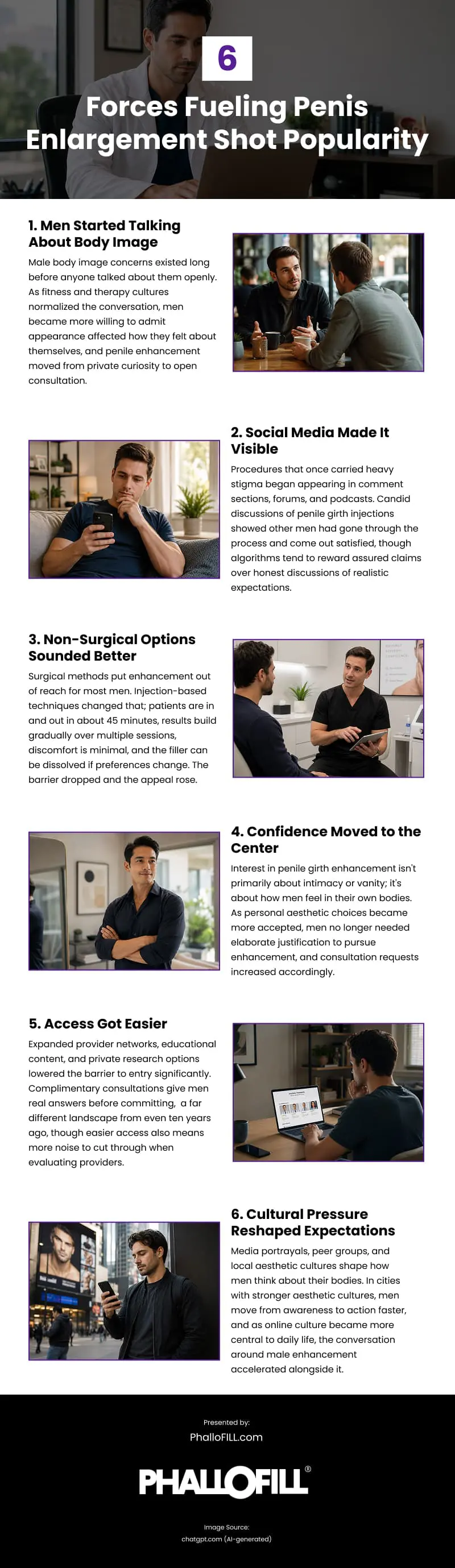
Infographic
Six converging forces pushed penile girth enhancement from private curiosity into mainstream conversation, driven by shifting attitudes toward male body image, social media visibility, and the rise of accessible non-surgical options. Explore six forces fueling penis enlargement shot popularity in this infographic.